

MEET OUR EXPERT
PHILIPP DROSTE
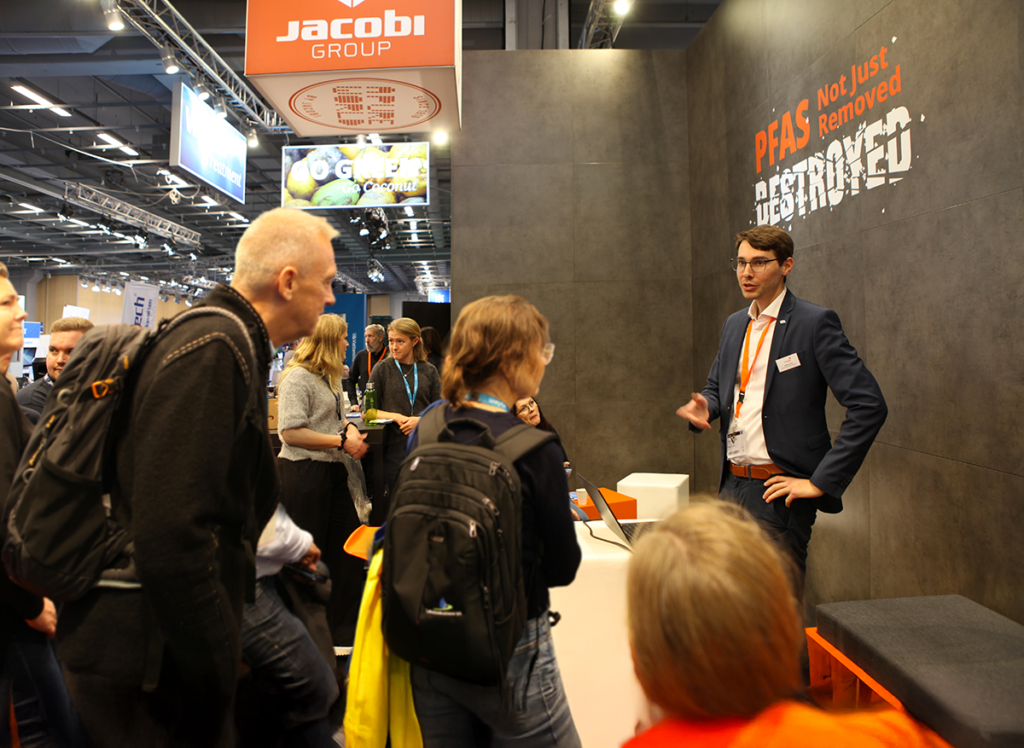
Jacobi has developed a method for solving the PFAS problem by breaking the strong carbon-fluorine bonds through thermal reactivation. Presented by Philipp at the Water 2025 fair 2025 in Sweden.
Jacobi is a business whose products and services are fundamentally reliant on science, and so our company is home to a multitude of technical specialists with deep expertise in their field. In between giving two lectures at the Water 2025 trade fair, Philipp Droste found some time for a chat with us about his background and career at Jacobi.
Hi Philipp, could you please tell us what you do at Jacobi?
My title is Technical Application Engineer, and I work with flue gas and water treatment. I have a consulting role in which I advise colleagues, primarily from the sales team, on choosing the right product and process design. I'm located in Germany, south of Frankfurt.
Looking back, could you share a little about your upbringing and early background?
I grew up with two younger siblings in Düsseldorf, in western Germany. Later, I went to a boarding school in Bonn.
How did you find being a pupil at a boarding school?
I was only eleven, so of course I missed my parents, but I usually came home at weekends. It was okay. The school situation in Düsseldorf was not good at the time, so this was a solution for me to get a good education.
When you headed off to university, what did you study?
I studied Environmental Engineering Sciences in Aachen for four years, a Bachelor of Science, followed by a two-year Master of Science in Sustainable Energy Supply. It's quite a broad programme and, at the time, I didn't have a clear idea of what I wanted to focus on; however, I quickly settled on water issues.
What was your first job?
During my studies, I started working as a student assistant at an institute for water treatment, at a wastewater treatment plant. There, I worked with activated carbon and products from Jacobi, among others. But my first job was at Jacobi as a Technical Application Engineer.
What challenges do you see in your work with our treatment solutions and things that customers come to us for help with?
Many of the questions and challenges relate to performance expectations and solution-finding. My goal is to meet these requirements by considering not only our products, but also the entire processing step.
If you were to attract someone to take an interest in our industry, what would you say?
Activated carbon is a very niche part of the chemical industry, but these products are essential in a large number of processes, such as in the drinking water production, food industry or air and gas applications. And they are important to our everyday life, which makes them interesting and meaningful to me.

See Philipp explain why he's stayed with Jacobi since graduating from university.
You have stayed with Jacobi since university; that’s seven years now. What has made you stay with us?
Because of the people and because it’s an interesting job. I get to know many people, not only from our organisation but also from other places. Even after all the years I have spent at Jacobi, there are new things to learn. People come to us with new ideas all the time and ask us to investigate whether our products could be used in their businesses.
In a previous issue of A Pure World, we discussed the ‘Jacobi spirit’. What do you think the Jacobi Spirit embodies?
I think the people here definitely have the Jacobi spirit. There’s a very positive culture where we are all on the same level with no hierachy. When I started, particularly in Germany, but probably also in other countries, people often talked about how the atmosphere was family-like.
Now, the company is bigger, with more than 2,000 people, but the family-like atmosphere remains, perhaps because Jacobi has never built hierarchical structures. We focus more on how we shape our teams and solve things.
You spoke at our booth during Vatten2025 – what was your presentation about?
I presented our solution to remove PFAS from drinking water and how to work together with the customer to find the perfect solution. This has been a six-year journey of research and testing, during which we have developed a method for solving the PFAS problem by breaking the strong carbon-fluorine bonds through thermal reactivation.
Using this method, we can reduce PFAS concentrations to below detectable limits. This is a huge step for us at Jacobi and our industry as a whole.
Thank you for this chat, Philipp, and good luck with your future career at Jacobi! Our solution to the PFAS problem puts us on the right track to solving the issue once and for all. You can read more about how we deal with PFAS problems on our dedicated PFAS page: jacobi.net/pfas