

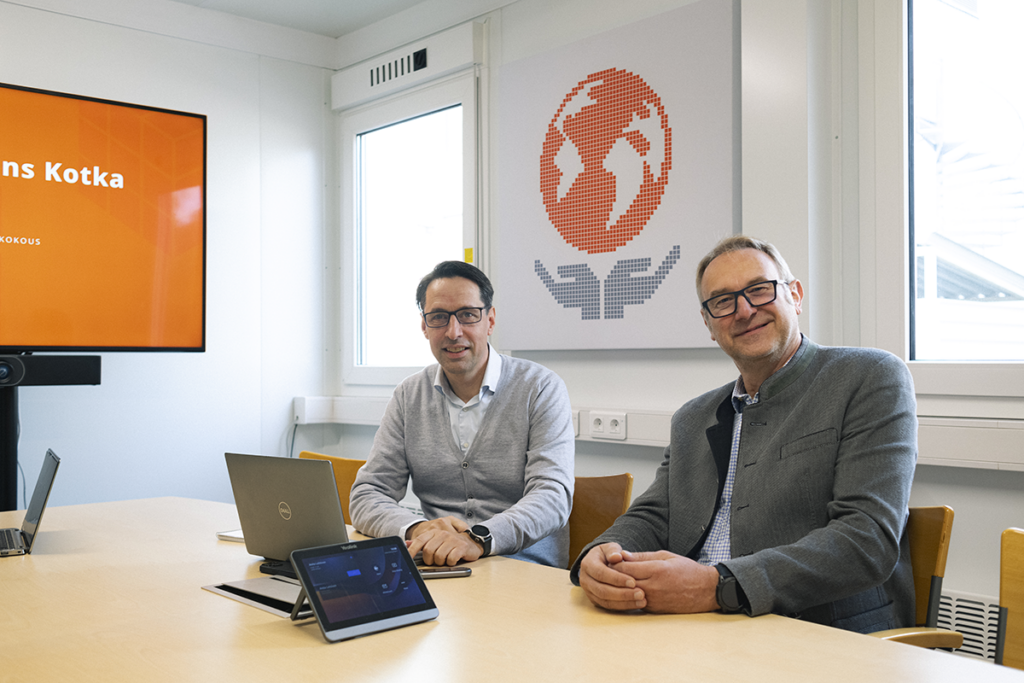
Magnus Fagerstedt (Finex Managing Director) And Andreas Kreindl (Global Commercial Director) meet to discuss customer product requirements from the Finex plant on a regular basis in order to efficiently manage inventory of our core ion exchange resins portfolio.
FINEX FUTURE:
A safer, more sustainable synthesis
Jacobi Group acquired the Finnish chromatographic resin producer, Finex, back in 2020 and, after adaptations to operations and processes, the site has gone from strength to strength.
The journey to improve lead times, streamline product offering and improve safety at the plant has been a great success so far; however, at Jacobi, we take a reflective approach to everything we do, and so the journey to optimise continues.
One of the most significant improvements to the safety and sustainability of the plant, is making the site entirely solvent free. Traditionally, the types of resins produced here would be made using toxic solvents.
Chlorinated solvents are widely used across the resin industry to open up the beads following polymerisation, thus allowing the unique molecule that provides the ion exchange properties to attach. Though their use makes production significantly easier, such solvents are confirmed to be toxic, both to humans and the environment.
We are a company that prioritises the protection of our planet and our people, taking every possible step to ensure their safety at work. By eliminating the use of chlorinated solvents, we can be sure that the environment and our personnel are not negatively affected.
Introducing Our Newest Sustainable Products From Finex
Over the past year, our teams in Kotka have developed new products, designed for improved efficiency and with environmental consideration in mind.
Firstly, MAK-38H, a sustainably produced methacrylate-based weak acid cation resin used in the production of milk whey, home water filters, and silicic acid for pharmaceuticals.
This resin is proudly made entirely in Europe, reducing the costs and emissions associated with logistics. Usually, this type of product would be made using acrylonitrile, a hazardous substance that generates both ammonia and cyanide. By using methacrylate in our production, not only are our teams safer, but the resin itself is pure white instead of yellow.
MAK-38H offers an optimal diffusion rate and significantly higher kinetics, and outperformed other commercial carboxylic exchangers in laboratory testing. The performance of this new product reinforces our belief that there is no need to compromise on functionality and results when you prioritise sustainability.
Solvent-Free Strong Acidic Cation Resin (SAC)
Ensuring water used in various manufacturing processes is correctly treated before use can make a big difference in preserving the operational efficiency of equipment such as boilers and other machinery that utilises process water. Build-ups of scale and other minerals can cause malfunction. Removing these hardness-causing minerals by correctly softening water using our strong acid cation (SAC) resins is the answer. Now produced completely without any solvents in the process, making them safer for all applications and more environmentally friendly than ever.
Proudly produced in the EU to help serve various markets in this part of the world, this solvent-free alternative is safer for the people working to manufacture it, as well as for customers deploying the resins in applications where humans will consume the end product.

As a producer of specialist resins for chromatographic separation as well as pharmaceutical applications, being situated in Europe ensures security of supply and full product support.
Working With What We Have to Optimise Our Production
Acquiring Finex meant our resins business footprint became lower than ever. Though this was an undeniably positive result, it did not mean we were satisfied. Sustainability is at the heart of our operations as a group, and this plant was no exception. We began to move our production toward being solvent free and as generally sustainable as possible.
To achieve our goal of solvent-free synthesis lab work was required. We conducted a study where we altered various parameters – quantities, time, etc. – with the aim of designing a solvent-free production line that would achieve the same quality and performance.
As well as moving away from solvents, we made other changes to improve production and environmental impact simultaneously. For example, increasing yields. By optimising production this way, making more from our raw materials, we are able to reduce loss into the environment and wastage. Any waste we do generate is tracked and monitored in terms of quality. Consistent monitoring means that we can be confident we are ready and prepared to make any necessary changes swiftly.
Now that we are manufacturing resin products in Europe, we must follow EU rules and regulations with regards to waste, a change that we knew was beneficial for the planet and one that we welcomed.
By making better use of our assets on site, modifying the geometry of some of our equipment, we have been able to drastically reduce the cycle to around a third of what it was when we took on the plant.
We are proud of the work and effort put in by our teams at the Finex plant, who have achieved these results with little monetary investment and a heavy focus on making process adjustments and optimising what equipment is already in our hands.

The Finex site based in Kotka, Finland, dates back to the 1950s. Resin production on site began in the 1980s.
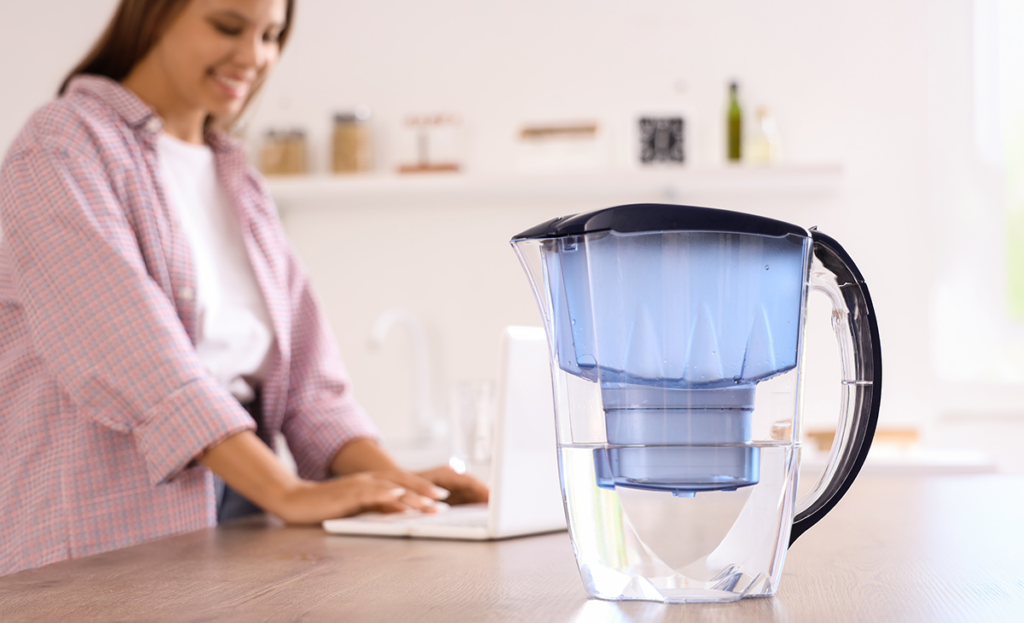
As part of a multi-stage filtration process often found in point of use water filter products in the home, weak acidic cation exchange resins are commonly used to soften water. Resinex™ MAK-38H is a high purity, premium grade, crosslinked methacrylic type of weak acidic cation exchange resin.
People’s Safety
In terms of personnel safety, the plant overall is safer than ever, thanks to the elimination of solvents on site and improved fire safety. For our teams, this means safer work practices but also serves as means of motivation for our people on how to work more sustainably. The push to remove resins from our production completely nudges our people to always be looking for the next opportunity to improve our environmental impact.
The biggest change Jacobi brought was safety on site. This was through various means, but most significantly through the replacement and upgrade of older equipment. The safety surrounding chemical operations has been a constant driving force since the addition of Finex to Jacobi Group and we are continually making changes, moving forward as team with safety and sustainability as the central focus of Finex’s future.
Product Diversification – A Secure Future
When optimising and looking at how we work with existing products, it is crucial that we broaden the approach by looking at new products and new applications that we can work within. By entering niche applications that perhaps have a single supplier, we are then able to support other markets and offer customers a new supply option, securing safety of supply overall.
With a more flexible approach to production on site, the future is exciting for Finex. As we progress through different milestones of ongoing improvement, we set clear and measurable goals – such as zero waste – to move forward with.
Each stage represents a new opportunity for progression, and we have a lot of plans under development behind the scenes. Our teams are driven by the desire to improve and, although making such changes will generate a lot of work, as a group, we know we can achieve.
“My own dream is to see Kotka as the education centre of resins for the group,” said Magnus Fagerstedt, Director at Jacobi Resins Kotka. “We have a good strong foothold already here with teams of knowledgeable people, from operators into product development.”
To find out more about our product portfolio, including the newly launched more sustainable product options in this article, you can visit our dedicated resins website at resins.jacobi.net.