Tackling PFAS One Step At A Time To Remove It, For Good
We’ve been working on our solutions to help our customers through their PFAS problems for several years now. This global crisis threatens people, wildlife and the environment and is an issue we are keen to help tackle. In recent months, both global awareness and improvements in our own offering have gathered momentum. In this article, we explore the latest PFAS updates from Jacobi.
PFAS chemicals have hard to break molecular bonds.
Many customers describe treating PFAS contamination as confusing. Firstly, a huge number of compounds (over 10,000) fall under the PFAS umbrella, with varying levels of effect. Rules and legal limits differ vastly geographically and can change both frequently and rapidly too. In the EU, for example, water supplies must comply with the PFAS20 directive where 20 specific compounds have been identified, and a 100ng/L limit must be adhered to. Elsewhere, both guidance and regulations vary, with many becoming increasingly strict.
The way tests are conducted can be another source of confusion. The framework used in the EU is known as the POP (persistent organic pollutants) limit and is considered unfit for purpose by many. This limit is largely unregulated, covers only three PFAS out of a possible 10,000, and doesn't test off gases or water generated from treatment.
The notion of zero PFAS, entire elimination of all existing PFAS, can also cause issues at the start of treatment. No PFAS at all is simply not possible, however, presence of PFAS can be lowered to undetectable, safe levels of parts per trillion.
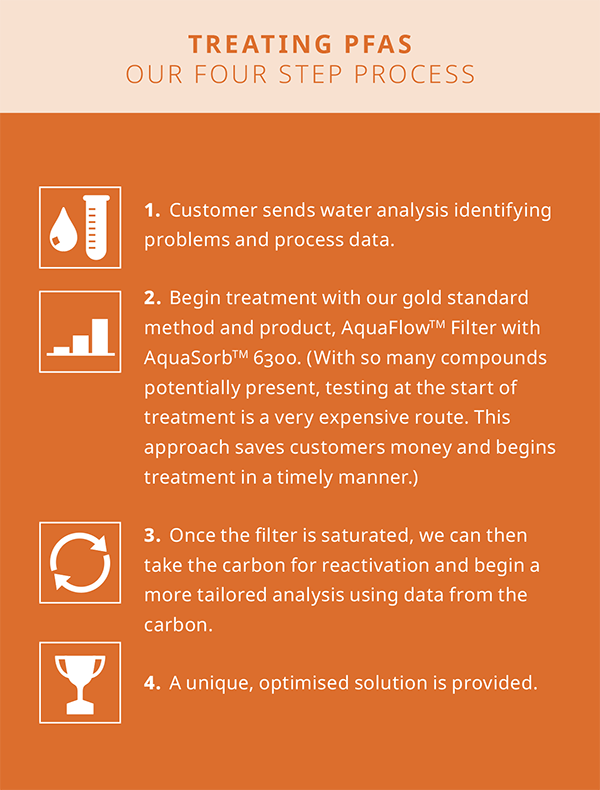
There are many external factors to consider when beginning PFAS treatment and this only increases when we look at customers’ individual internal circumstances. At Jacobi we recognise that every situation is different and that there is simply no one-size-fits-all approach. Because of this, we promise all our customers a tailored approach entirely bespoke to their individual needs.
Testing Options with Jacobi
Customers can choose from two types of testing: targeted analysis or adsorbable organic flourine (or AOF) testing.
Targeted analysis is a sensitive test that looks at a predefined set of 20–40 compounds and allows detection limits in the low parts per trillion range. This is a precise test that’s often considered the gold standard of PFAS testing. Such precision comes at a price, however, and targeted analysis is expensive for customers. Not only is it costly, but the wait times are long too, with results being ready in two to three weeks.
The second option, AOF testing, offers a quicker screening process that cannot distinguish between one PFAS or another, but can offer an idea of the PFAS levels within the low parts per billion range. This method is done in-house, and results can be obtained within a two to three hours.
Despite the accuracy of targeted analysis, most of our customers opt for AOF testing, avoiding long waits (on top of the testing time, a filter loaded with PFAS saturated carbon is quarantined too) and high costs. AOF is popular amongst customers thanks to its competitive pricing and ability to offer a broad-spectrum view of PFAS levels (including unknown and emerging compounds) within the spent carbon. A wider view is extremely helpful, especially when delivered so quickly. With a clear picture of what is going on, we can use this method to screen and monitor for trends and help our customer to decide if targeted analysis is required.
Taking on Industrial PFAS Carbon
With PFAS in our water sources, the drinking water industry has historically been the most commonly known source of PFAS saturated carbon. Industrial applications too – including airports, paper mills, chemical manufacturing, ground remediation processes, landfill leachate treatments, and textile production – are significant sources too. Jacobi is now authorised to treat PFAS problems and reactivate PFAS saturated carbon within these fields.
Complete Destruction of PFAS
If PFAS is removed, collected and relocated, the problem still exists, simply somewhere else. At Jacobi, we do not see this a satisfactory treatment outcome. With ambitious goals and high standards when it comes to sustainability, relocating a hazardous substance and letting it create problems in a new place is not an option for us.

Testing throughout the capture and destruction process is essential.
At our plant in Vierzon, France, PFAS is removed from the spent carbon through reactivation, a method that allows the carbon to be recycled through heating at extremely high temperatures. Not only does this completely destroy the PFAS, it also renders the carbon usable once again, saving our customers money and significantly lowering emissions and global warming potential when compared to buying brand new carbon.
Jacobi’s Standards and Working the Right Way
Exceptionally high standards and a commitment to the safety of our personnel and the protection of the planet are both high priorities and significant parts of our company’s identity. These standards extend into every aspect of our operations and PFAS treatment is no exception.
When taking in PFAS for treatment, our acceptance criteria is strict. If the levels of PFAS are extremely high, we make the decision to reject the business because of the risk it poses to our plant workers and the surrounding environment.
The EU’s POP limit we discussed earlier in this article only requires the carbon itself to be tested to ensure that the treatment has been successful. The carbon is, in fact, only one part of the problem. We know PFAS can escape into the atmosphere through off gases and be released into the environment through wastewater too. At Jacobi we take responsibility for these elements too, prioritising the future of the planet and safety of the people working in our plants and living nearby, by testing them alongside the carbon.

Handling spent activated carbon requires great care on site.
The dynamic nature of the PFAS treatment industry combined with our sustainability ambitions and our responsibility towards the planet mean we are keen to help to improve and develop PFAS treatment options.
Currently, ion exchange resins are not an approved treatment method for dealing with PFAS levels in drinking water in Europe. Though it is well documented that resins are the best way to remove short chain compounds, drinking water suppliers generally remain conservative in their approach and, rightfully, require comprehensive testing before approving new methods.
Alongside another company, Jacobi Resins products are in trials with German water company, Rauental Waterworks, in Rastatt, Baden-Württemberg. After this extended efficacy test, it is hoped that the use of resins will gain nationwide approval, providing an extra line of treatment and safer drinking water in Germany.

PFAS are a large group of man-made chemicals that are used widely in the production of many household items. Incredibly useful, they are prevalent in the home and in industry. The robust nature of these chemicals makes them hard to break down and difficult to remove. Multiple negative health effects have been linked to PFAS contamination.
Jacobi have been a significant presence within the PFAS field for some time now and we are acutely aware of the confusion, panic and urgency that a PFAS problem can cause for customers. Our experts know this application and its intricacies well and are able to offer guidance within all aspects.
We can offer technical expertise to clear up any confusion, and create a tailored treatment plan that eliminates the PFAS completely, all whilst working in the ethical and environmentally considerate and responsible manner that our planet and its inhabitants deserve.
If you have a PFAS problem you need help with, email our experts directly on PFAS@jacobi.net.